This glossary contains the words people can use to talk about Social Sciences.
anthropology
noun
The study of human societies and cultures and their development.
Example: In time, academic anthropology became less directly associated with evolutionary ideas, and it tried to establish itself as a respectable, if not conservative, branch of the Social Sciences.
fr: anthropologie
archaeology
noun
The study of human history and prehistory through the excavation of sites and the analysis of artifacts and other physical remains.
Example: Chronology of building forms can be established only approximately, and archaeology cannot tell us of variations in the prosperity of a community from one year to the next.
fr: archéologie
behavior
noun
The way in which one acts or conducts oneself, especially toward others.
Example: Considered as an independent variable, how does it affect behavior in various sectors of life?
fr: comportement
economics
noun
The Social Science that studies the production, distribution, and consumption of goods and services.
Example: The Kendrick Educators in Economics Program will increase the investment in teachers to increase outreach in youth economic education statewide.
fr: économie
education
noun
The process of receiving or giving systematic instruction, especially at a school or university.
geography
noun
The study of the physical features of the earth and its atmosphere, and of human activity as it affects and is affected by these, including the distribution of populations and resources, land use, and industries.
Example: Readers interested in social policy should not be put off by the disciplinary context of geography: in many respects present - day geography is the next - door neighbour of social policy studies.
fr: géographie
history
noun
The study of past events, particularly in human affairs.
Example: In 1962 Piero Pieri addressed a Parisian audience on how he saw military history "spilling over" into other aspects and specialisms of history, creating chain reactions which would bind them all together.
fr: histoire
human
noun
Relating to or characteristic of people or human beings.
Example: Such people manifestly lack those human characteristics a society both produces in its members and relies on for its continued existence.
fr: humain
knowledge
noun
Facts, information, and skills acquired by a person through experience or education; the theoretical or practical understanding of a subject.
Example: They locate the category of "knowledge" in a social context rather than an epistemological one; it is not the validity of knowledge but how it is used that is of importance to the sociology of knowledge.
fr: connaissances
law
noun
The system of rules which a particular country or community recognizes as regulating the actions of its members and which it may enforce by the imposition of penalties.
Example: The concepts of a right and a liberty (as opposed to freedom generally) probably originated however, in systems of juridical law, and it is in legal systems that they have their most subtle and interesting applications and most thorough and detailed elaborations.
fr: loi
method
noun
A particular form of procedure for accomplishing or approaching something, especially a systematic or established one.
Example: This is a common, everyday method of explaining things.
fr: méthode
multidisciplinary
adjective
Combining or involving several academic disciplines or professional specializations in an approach to a topic or problem.
Example: Modernisation theory represents a multidisciplinary effort to examine the prospects for Third World development.
fr: multidisciplinaire
political science
noun
The branch of knowledge that deals with systems of government; the analysis of political activity and behavior.
Example: Political science does not have a systematic understanding of order.
fr: science politique
psychology
noun
The scientific study of the human mind and its functions, especially those affecting behaviors in a given context.
Example: Since this approach allows subjectivity to be addressed through the unconscious, it is particularly valuable in psychology.
fr: Psychologie
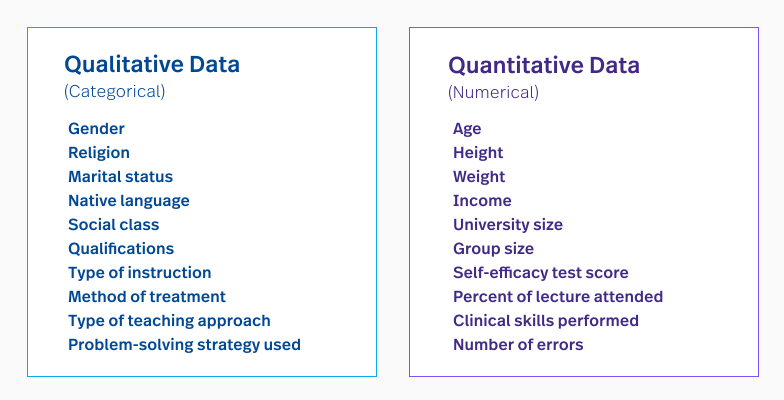
qualitative
adjective
Relating to, measuring, or measured by the quality of something rather than its quantity.
Example: Anthropological analysis of these beliefs, I believe, should add a crucial semantic dimension to compliment the many non-qualitative enquiries into policing now in progress.
fr: qualitatif
relation
noun
The way in which two or more concepts, objects, or people are connected; a thing's effect on or relevance to another.
Example: The relation of slaves and freemen is, however, for Marx and Engels a true class relation.
fr: relation
research
noun
The systematic investigation into and study of materials and sources in order to establish facts and reach new conclusions.
Example: But every piece of research carried out is a contribution to some area of knowledge and the contribution made need not necessarily be challenging the views of the founding fathers of a discipline.
fr: recherche
social
noun
Relating to society or its organization.
Example: There were obviously men in Hollywood who wanted to use social themes, there were audiences who were willing to attend these films, and there were critics who were prepared to praise and even honour these films.
fr: social
society
noun
The aggregate of people living together in a more or less ordered community.
Example: In general, then, supporters of the "society- as - parent" view tend to favour changes in the 1975 Children Act which facilitate the removal and transfer of parental rights.
fr: société
sociology
noun
Sociology is the study of human social relationships and institutions.
Example: Such a view of "sociology" sets up another binary derived from the police preference for a Manichean world created on homologizes of "good - evil", and further reflects the ferocious resistance to and fear of change which permeates the organization (see for example Weatheritt 1986, Butler 1984, and Adams 1988).